Meta, for most apps, at most budgets. TikTok as well, but only for a specific kind of product, and the teams that get this wrong usually got it wrong because they compared the two channels on the cheapest number instead of the one that pays the bills.
Here is how to work out which one you are.
Page Contents
The wrong question, and the right one
“Which drives more installs” has a clear answer and it is almost useless. TikTok can drive a very large number of very cheap installs for the right product. Cheap installs are easy to buy on any channel if you do not care who they are.
The question that decides your budget is which channel drives the most users who are still there in a week and eventually pay, per dollar spent. Once you ask it that way, the answer changes by product, and the two channels stop looking like substitutes.
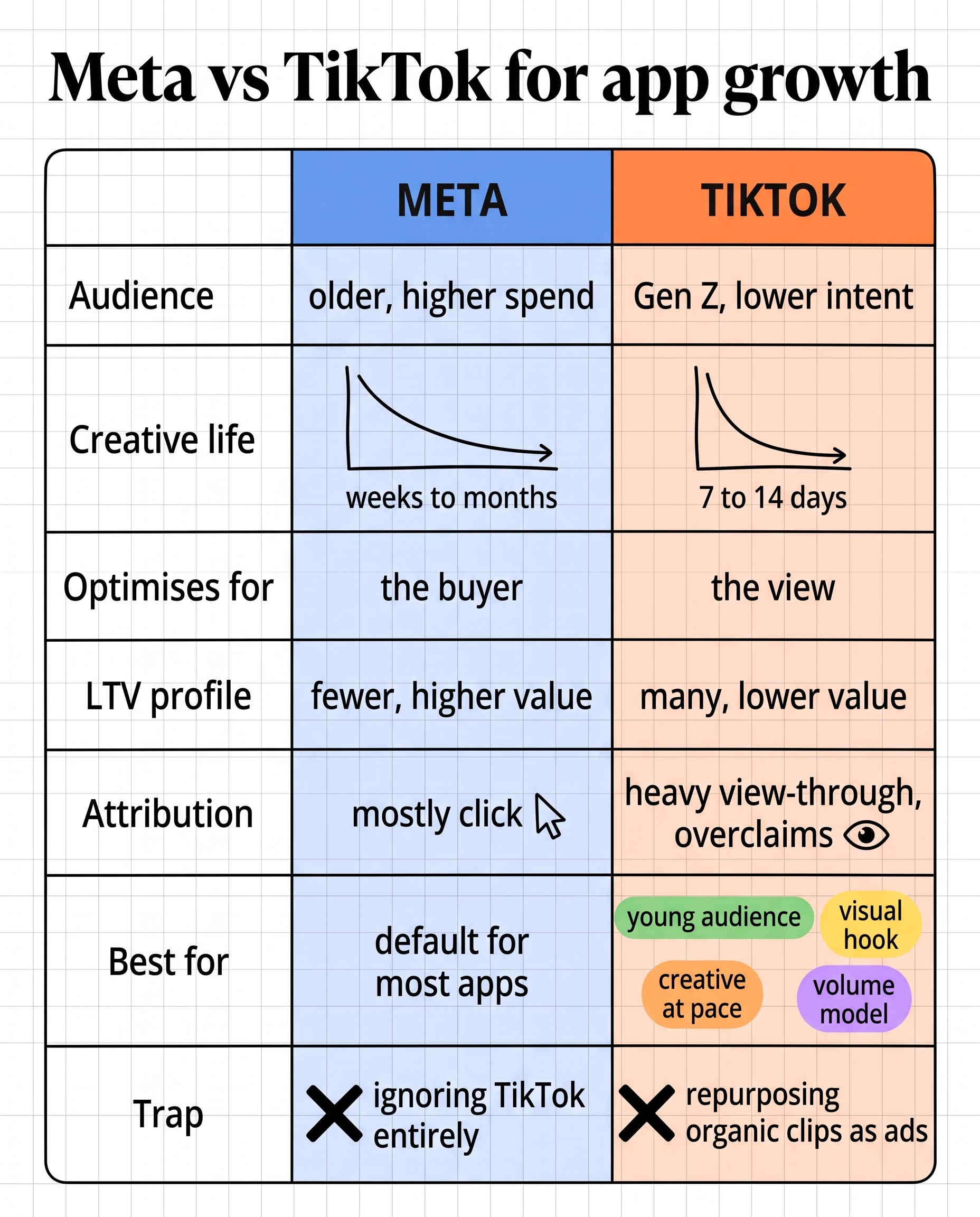
Meta is the default for a reason. Its audience skews older and spends more, its creative holds up longer before it wears out, and its delivery system has had more years of conversion data to learn from. TikTok is conditional. It wins when the product fits the platform, and loses money when it does not, regardless of how good the CPMs look.
The four tests
TikTok should be your primary install channel only if three of these four are true.
1. Your audience is young. Gen Z or younger millennial. If your buyers are in their forties, you can reach some of them on TikTok, but you will pay for a great deal of inventory that is not them.
2. Your product has a visual or entertainment hook. Something that shows well in a nine-second vertical clip without explanation. A card game, a camera app, a social feature, a transformation. If your value has to be explained, TikTok punishes you for it.
3. You can sustain creative production at pace. This is the one most teams fail. TikTok creative fatigues in roughly seven to fourteen days. Meta creative can run for weeks or months. A TikTok programme without a creative engine behind it burns out within a month, and the CPMs that looked cheap in week one are buying a dead ad by week three. We wrote up the arithmetic in how many ad creatives you should test per week.
4. Your LTV works on low-intent, high-volume users. TikTok is built for virality, so it is far easier to buy a low CPI than a high-value user. If your business depends on a small number of heavy spenders, TikTok’s users will mostly not be them. If your model is a lot of users at a modest price, it can be excellent.
If none of the four apply, TikTok is a diversification channel at most, and Meta is where your budget belongs. If all four apply, you may genuinely be a TikTok-first company.
Three kinds of product that are TikTok-first
Across the accounts where TikTok has been the scale channel rather than the side bet, three patterns repeat.
- Products with a social component. Apps built around sharing, community, or co-creation. TikTok’s algorithm rewards content that sparks engagement, and ads for these products behave like content.
- Low-ARPPU products that are not whale-driven. Ad-monetised games, low-price subscriptions, affordable consumer goods. Volume is the model, and volume is what TikTok sells.
- Products with strong organic traction on TikTok already. If your brand or category is already moving there organically, paid is an amplifier on something that works rather than a bet on something that might.
Notice what is not on this list: high-ticket subscriptions, fintech, anything whose buyers are older and deliberate. Those are Meta products.
Why TikTok CPAs run high even when the CPMs are low
When a TikTok programme underperforms, it is usually one of three things, and none of them is the platform.
Repurposed organic content. A clip that went viral organically was optimised for attention. A direct-response ad needs a structure: hook, value, reason to act, call to action. Engagement is not conversion, and the algorithm will happily deliver the former without the latter.
One hero ad instead of a portfolio. A single winning ad scaled across an audience is not a strategy. A working TikTok account runs something like eight to twelve distinct hooks, each speaking to a different slice of the same audience, and rotates them as they fatigue.
Narrow targeting to “save money”. TikTok’s own 2026 Performance Advertisers Report puts average CPI at $1.58 for broad targeting, $1.74 for interest targeting and $1.96 for custom audiences. Tighter costs more, not less. The delivery system finds your buyers better than your interest list does, on TikTok as on Meta.
The measurement trap: TikTok’s numbers are not Meta’s numbers
TikTok’s reported conversions carry a much larger share of view-through attribution than Meta’s. Far more people on TikTok watch an ad and do not tap it, then install later from the App Store or from another ad. TikTok’s default attribution window claims a large share of those installs as its own. So the TikTok dashboard and the Meta dashboard are not counting the same kind of event, and putting them side by side flatters TikTok.
Two consequences. First, a TikTok install that also shows up as a Google or Apple Search Ads install, or as an organic one, gets counted twice across your dashboards, and the sum of the platforms will exceed what your MMP or your app store says actually happened. Second, when you cut TikTok and its “conversions” reappear under another channel, that is not evidence TikTok was seeding demand. It is evidence the conversions were never uniquely TikTok’s in the first place.
Judge TikTok on click-through conversions, on the MMP’s deduplicated total, or on an incrementality test. Never on TikTok Ads Manager versus Meta Ads Manager. We go into what the platform dashboards do and do not show in how to analyze ad creative performance, and into the iOS side of it in how to fix mobile attribution on iOS.
How to sequence them
- Start on Meta unless you pass three of the four tests. It is the more forgiving channel: older audience, longer creative life, deeper optimisation history.
- Test TikTok once you have a creative engine, not before. If you cannot ship new concepts weekly, you cannot run TikTok properly, and the test will fail for reasons that have nothing to do with fit.
- Give a TikTok test its own creative. Native vertical, hook in the first second, built as direct response. Do not push your Meta winners onto TikTok and read the result as a verdict on the channel.
- Judge on cost per retained or paying user, deduplicated. Not CPI, not platform-reported installs.
- Read TikTok on click-through and deduplicated numbers. If the blended cost per paying user improves when TikTok is on, keep it on. If only TikTok’s own dashboard improves, it is claiming installs that were happening anyway.
For a three-way comparison with Apple Search Ads and Google in the mix, see Google Ads vs Apple Search Ads vs Meta for app installs.
This post is part of our guide to how to choose a mobile UA agency.
Frequently asked questions
Should you advertise on Meta or TikTok? Meta, for most apps, and TikTok as well if three of four things are true: a young audience, a visual or entertainment hook, creative production fast enough to beat one-to-two-week fatigue, and a business model that works on lower-intent, higher-volume users. If none apply, TikTok is diversification at most.
Which drives more app installs, Meta or TikTok? Meta, for most apps at scale. TikTok can drive more, and cheaper, installs for products that fit the platform. Installs are the wrong unit anyway: compare cost per retained or paying user, deduplicated through your MMP, because TikTok’s reported installs carry far more view-through attribution than Meta’s.
Is TikTok cheaper than Meta for app installs? Usually on CPM and often on CPI. That is not the same as cheaper per paying user. TikTok’s audience skews younger and lower-intent, and its creative fatigues in one to two weeks, so the cheap installs come with higher creative costs and lower value per user unless your product fits the platform.
Should a gaming app pick Meta or TikTok? Depends on the game. Casual and ad-monetised games with a strong visual mechanic and a volume model are often TikTok-first. Midcore and whale-driven games are Meta and network products. Apply the four tests: young audience, visual hook, creative pace, low-intent LTV.
How much creative does TikTok need compared with Meta? Considerably more. TikTok creative fatigues in roughly seven to fourteen days versus weeks or months on Meta. Plan for a rotating portfolio of eight to twelve distinct hooks, not one scaled winner.
Why did my numbers not drop when I cut TikTok? Because the conversions TikTok was reporting were largely view-through: people who saw the ad, did not tap, and installed via another channel or organically. Those installs were already counted elsewhere. Check the MMP’s deduplicated total and TikTok’s click-through conversions, not the platform dashboards.
Does narrow targeting reduce CPI on TikTok? No. TikTok’s 2026 Performance Advertisers Report reports broad targeting at $1.58 CPI, interest targeting at $1.74 and custom audiences at $1.96. Broad is cheapest.