Creative velocity, the rate at which a mobile gaming studio can produce, test, and iterate on ad creatives, has become the single most important lever for scaling user acquisition in 2026. According to AppLovin's State of Creative Optimization report, the top 10% of mobile gaming advertisers produce 5x more creative variants per week than median performers and achieve 40-60% lower CPIs as a result. In our experience managing creative pipelines across gaming portfolios at varying spend levels, the pattern is consistent: studios that ship a high volume of new creatives weekly sustain scale, while those with low output tend to hit performance ceilings quickly.
Page Contents
What is creative velocity in mobile gaming UA?
Creative velocity is the number of net-new ad creative variants a mobile gaming studio ships into live campaigns per week. According to Sensor Tower’s 2025 State of Mobile Gaming report, top-grossing mobile games test an average of 70-120 unique creative variants per week across Meta, Google, TikTok, and AppLovin. It is distinct from creative volume (total assets in rotation) because velocity measures the rate of fresh production.
Creative velocity matters because ad platforms reward novelty. Meta's ad delivery system penalizes ad sets where creative engagement declines, which industry patterns suggest typically begins within the first week of launch for many gaming campaigns. According to a 2024 AppsFlyer creative optimization study, stale creatives see CPMs rise 15-30% once they have been shown to the same audience segments repeatedly. High velocity counteracts this by constantly refreshing the pool before fatigue sets in. The metric is not just about raw output: it encompasses the full pipeline from concept to live ad, including ideation, production, QA, upload, and launch. For a deeper look at this dynamic, see our breakdown of creative fatigue and how to fix it.
- Creative velocity = net-new variants shipped into live campaigns per week
- Top mobile gaming advertisers average 70-120 variants/week per Sensor Tower's 2025 State of Mobile Gaming report
- Mobile apps commonly see fatigue onset on Meta within the first week of a creative's launch
- Velocity covers the entire pipeline: concept, production, QA, launch
Why does creative velocity matter more than creative quality in mobile gaming?
It does not replace quality, but velocity compounds quality's impact. In our experience working across gaming clients, only 5-15% of creatives beat the control in any given test cycle. This aligns with findings from AppsFlyer's creative optimization research, which reports that fewer than 1 in 10 ad variations meaningfully outperform a baseline. At a 10% hit rate, shipping 100 creatives per week yields 10 winners, while shipping 20 yields just 2.
According to AppLovin's State of Creative Optimization report, creative is responsible for 70-80% of campaign performance variance on their network, dwarfing the impact of bidding strategy or audience targeting. The implication: if your hit rate is roughly fixed (and it is, within a narrow band), the only way to find more winners is to test more variants. This is especially true post-ATT, where algorithmic signal loss as described by Eric Seufert on MobileDevMemo means platforms lean more heavily on creative engagement signals to optimize delivery. For a deeper comparison, our guide on creative testing vs audience testing explores how this dynamic plays out across channels.
How many creatives per week do mobile games need at different spend levels?
In our experience, the minimum viable creative velocity scales roughly with spend. Higher-spending games generally require meaningfully more weekly creative output to sustain performance, as larger budgets exhaust audience pools and trigger fatigue faster. According to Unity’s 2025 mobile gaming benchmark report, higher-spending titles in premium genres face even steeper velocity requirements to maintain efficiency.
The relationship between spend and required velocity is not linear. At lower spend levels, fewer creatives can sustain performance because audience pools are not exhausted as quickly. As spend scales, frequency increases, fatigue accelerates, and the platform needs more fresh signals to optimize against. The table below shows general benchmarks based on patterns we observe across gaming accounts at different spend tiers.
What systems increase creative velocity for mobile gaming teams?
The four systems that consistently drive high creative velocity are templatized production, AI-assisted variation, outsourced creator networks, and in-house studios. Most top-performing gaming advertisers use at least three of the four simultaneously, per RocketShip HQ observations across scaled portfolios.
Need help scaling your mobile app growth? Talk to RocketShip HQ about how we apply these strategies for apps spending $50K+/month on UA.
Each system serves a different purpose in the pipeline. Templatized production handles volume. AI-assisted variation handles iteration speed. Creator networks handle diversity of style and perspective. In-house studios handle high-conviction hero assets. The mistake most studios make is trying to solve velocity with just one system. At RocketShip HQ, we use a modular creative system where 5-6 hooks x 3-4 narratives x 2-3 CTAs x 4 personas = 240-360 unique permutations from a single creative concept. This approach applies directly to gaming: a single gameplay capture session can yield 100+ ad variants when modularized properly.
- Templatized production: pre-built motion graphics templates where gameplay footage, text overlays, and CTAs are swappable. In our experience, this approach dramatically reduces per-asset production time compared to bespoke creation.
- AI-assisted variation: tools like generative AI for background swaps, voiceover, and text overlay iteration. According to data.ai's 2025 State of AI in Mobile report, studios using AI for creative variation report 3-4x higher output per designer.
- Outsourced creator networks: UGC and creator-style ads from platforms like Billo, Insense, or agency networks. Costs per asset vary depending on platform and creator tier, so budgeting expectations should be set in advance with your chosen network.
- In-house studios: dedicated teams for hero concepts and high-production playables. Typically 1-2 hero assets per week that inform 50-100 templated derivatives.
How does templatized creative production work for mobile games?
Templatized production uses pre-built After Effects, Figma, or proprietary tool templates where specific modules (hook, gameplay footage, end card, CTA) are independently swappable. In our experience, templatization dramatically reduces marginal production cost per variant compared to bespoke creation.
The key insight from building a creative testing roadmap is that you test at the concept level first, then iterate winning concepts at the module level. This prevents wasting velocity on variants of losing concepts. A creative strategist defines hook concepts, a motion designer builds each as a modular component, and a production coordinator assembles permutations using scripting or tools like Celtra or Superside.
What tools do mobile gaming studios use for templatized creative production?
The most common tools in 2026 are After Effects with scripted rendering, Celtra for dynamic creative optimization, and custom internal tools built on top of FFmpeg or Remotion. According to Adjust's 2025 Mobile App Trends report, studios using automated rendering pipelines produce 2.5x more variants per full-time creative team member than those using manual workflows. Playable ad creation has its own toolchain, with Luna (by Unity) and Mintegral's Mindworks being the most widely adopted for interactive ad formats.
How is AI changing creative velocity for mobile gaming in 2026?
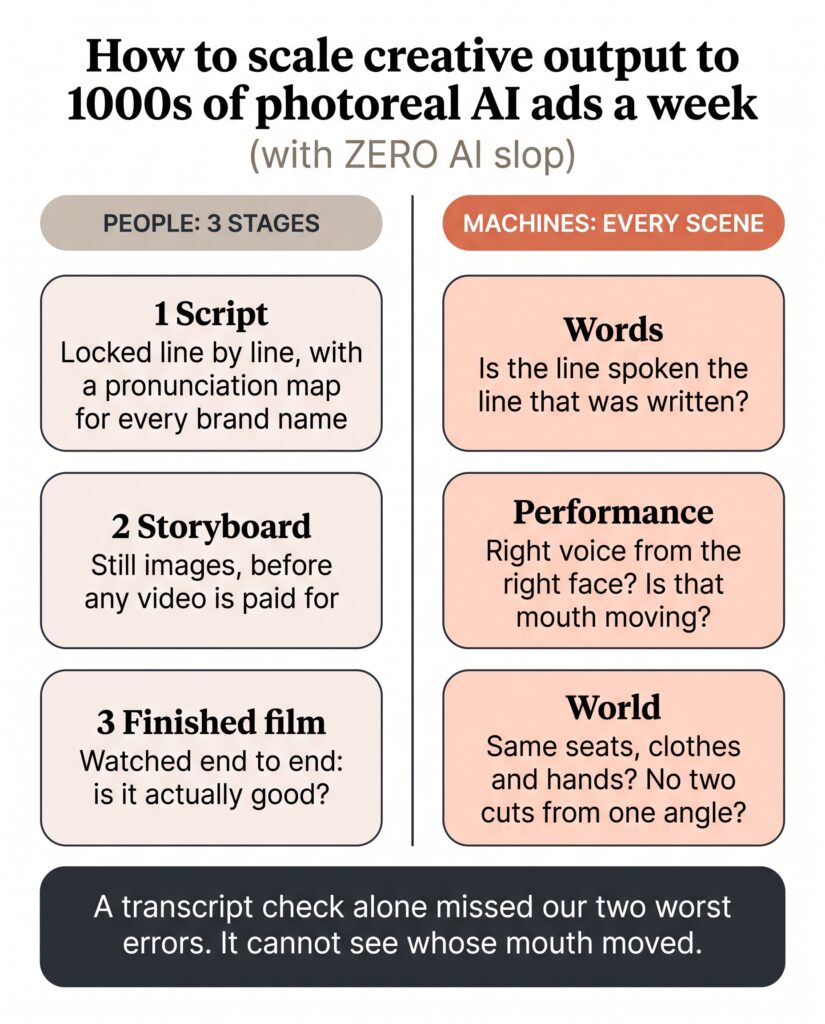
AI has meaningfully compressed the variation layer of creative production, based on our experience working across gaming clients. A single designer using AI tools can now produce significantly more ad variants per day than without AI, primarily through automated background generation, voiceover synthesis, and text overlay iteration.
The biggest impact areas are: (1) generative backgrounds and scene composition, where tools like Midjourney and Runway replace manual 3D rendering; (2) AI voiceover, where platforms like ElevenLabs produce localized VO in 20+ languages at a fraction of the cost of human VO; and (3) AI-driven variation engines that take a winning creative and automatically generate 10-20 permutations. Our guide to AI apps handling creative fatigue illustrates how these tools integrate into a production pipeline. According to data.ai's 2025 State of AI in Mobile report, 62% of top-200 grossing mobile game publishers now use generative AI in some part of their creative workflow. The key limitation remains that AI struggles with strategic creativity: identifying what emotional hook or gameplay moment to feature still requires human judgment.
- AI background generation saves meaningful production time per asset on environment-heavy game ads
- AI voiceover costs a fraction of human VO per asset, making localization at scale far more accessible
- Automated variation engines produce 10-20 permutations from one winning asset
- According to data.ai, 62% of top-200 grossing mobile game publishers use generative AI in creative workflows
Should mobile gaming studios outsource creative production or build in-house?
The answer is both. Mobile apps in this category typically see the best results from a hybrid model: a small in-house team (2-4 people) focused on strategy and hero concepts, supplemented by outsourced production for templated volume and UGC-style assets, a structure widely endorsed by practitioners including Eric Seufert on MobileDevMemo. Understanding what a performance creative agency delivers helps studios decide which functions to outsource versus build internally. Studios that go fully outsourced lose strategic control; those that go fully in-house cannot sustain the volume needed above $500K/month.
The cost math is straightforward. An in-house creative team of 4 (1 strategist, 2 designers, 1 video editor) carries significant fully-loaded annual cost in the US—typically well into the six figures per head when salary, benefits, and overhead are included. That team can produce 30-50 high-quality variants per week. Outsourcing the remaining volume at $150–$400 per asset for UGC or $50–$100 per templated variant means scaling to 100+ variants per week carries meaningful outsourced production costs. Agencies like RocketShip HQ sit between these models, offering scaled creative production with strategic oversight that bridges the gap. The key deciding factor is creative velocity requirements: if you need 80+ variants per week, pure in-house is rarely sufficient.
How do you measure whether your creative velocity is working?
Track three metrics weekly: new variants launched, creative hit rate (percentage of variants beating the control on CPI or ROAS), and creative contribution to spend (what share of total spend flows to creatives launched in the last 14 days). In our experience working across gaming accounts, healthy programs see 60-80% of spend concentrated on creatives less than 14 days old.
The most revealing metric is creative contribution to spend. If 50%+ of your budget is flowing to creatives older than 3 weeks, your velocity is too low and you are paying a fatigue tax. According to Meta's ad delivery documentation, the platform will shift delivery toward fresher assets when engagement signals are stronger, meaning high-velocity advertisers naturally capture more efficient impressions. We track this weekly at RocketShip HQ using a dashboard that flags when any creative exceeds a 14-day window at more than 10% of spend. For the framework we use to make these decisions, see our guide on A/B testing ad creatives.
- New variants launched per week: tracks raw output against targets from the spend-level table above
- Creative hit rate: 5-15% is a healthy range, aligning with AppsFlyer's benchmark of fewer than 1 in 10 outperforming baseline
- Creative contribution to spend: 60-80% of budget should flow to creatives under 14 days old
- Fatigue flag: any single creative exceeding 10% of spend after 14 days signals velocity shortfall
How do you scale creative velocity without ballooning costs?
The key is separating concept development (expensive, human-driven) from variant production (cheap, systematizable). In our experience, studios that adopt a modular approach consistently spend less per variant while producing significantly more output than those using bespoke production for every asset. AI-powered creative workflows enable production scaling, making the cost-velocity tradeoff increasingly favorable.
The cost structure breaks down into three tiers. Tier 1 is hero concept development: a small number of new concepts per week produced by senior creatives who understand game positioning and player psychology. Tier 2 is modular variation: taking winning concepts and producing many permutations per concept using templates and AI tools at low marginal cost. Tier 3 is localization and format adaptation: resizing, translating, and reformatting winners across channels at minimal incremental cost per variant. According to RevenueCat's 2025 State of Subscription Apps report, subscription gaming apps that invest in localized creative variants for top-5 markets see 25-35% higher LTV per install in non-English markets. The lesson applies broadly: the cheapest way to increase velocity is to extract more variants from concepts you have already validated. Our guide on scaling ad spend without losing ROAS covers the budget-side mechanics of this approach.
Creative velocity is not a nice-to-have in mobile gaming UA. It is the operational capability that separates studios that scale from those that plateau. Start by benchmarking your current output against the spend-level table above, identify which of the four production systems (templatized, AI-assisted, outsourced, in-house) you are underutilizing, and build toward a weekly cadence that keeps 60-80% of your spend on creatives under 14 days old. If you need help building or scaling that pipeline, RocketShip HQ’s creative production framework is a good place to start.
Frequently Asked Questions
What is the biggest mistake gaming studios make when trying to increase creative velocity?
The most common mistake is increasing volume without a testing structure, essentially shipping more variants without a system to identify winners. In our experience, studios without a structured creative testing roadmap waste a significant share of their production budget on variants that never receive enough impressions to reach statistical significance.
How does creative velocity differ between Meta, TikTok, and AppLovin?
Fatigue timelines vary significantly by channel. We've observed that TikTok creatives tend to fatigue fastest, Meta sits in the middle, and AppLovin creatives tend to sustain longer because the ad-network format delivers to broader, less repetitive inventory. Studios running $500K+/month across all three channels should plan for channel-specific velocity targets. LiveOps-driven event creative calendars by naturally refreshing hooks around in-game events.
Can playable ads be produced at high velocity like video ads?
Playable ads have inherently lower velocity because of their interactive complexity, but modular playable frameworks are closing the gap. According to ironSource (now Unity Ads) benchmark data, top gaming advertisers produce 5-15 playable variants per week compared to 50-120 video variants, but playables deliver 20-30% higher IPM (installs per mille) on average, making each variant more impactful.
How do you prevent creative velocity from overwhelming your QA process?
Automated QA is essential above 50 variants per week. At RocketShip HQ, we use scripted checks that validate aspect ratios, safe zones, audio levels, and file sizes before any asset enters an ad account. In our experience, automated QA consistently catches assets that would otherwise launch with rendering errors or incorrect specs, saving meaningful manual review time per week per account.
What role does competitive intelligence play in maintaining creative velocity?
Monitoring competitor creatives is one of the highest-ROI inputs to your concept pipeline. According to Sensor Tower's Pathmatics ad intelligence platform, the top 50 mobile game advertisers refresh their creative libraries 2-3x faster than the industry median. At RocketShip HQ, our creative strategists review competitor ad libraries on the Meta Ad Library and TikTok Creative Center weekly, sourcing a meaningful share of new concept hypotheses from patterns observed in competitor campaigns.
Does creative velocity impact organic metrics like app store conversion rates?
Yes. High-velocity paid creative testing generates insights that directly improve store listings. We've observed that studios feeding top-performing ad hooks into their App Store and Google Play screenshots can see meaningful improvement in organic conversion rate. According to Phiture's ASO benchmark research, coordinating paid creative learnings with store page optimization is one of the most underleveraged growth tactics in mobile gaming.
Looking to scale your mobile app growth with performance creative that delivers results? Talk to RocketShip HQ to learn how our frameworks can work for your app.
Not ready yet? Get strategies and tips from the leading edge of mobile growth in a generative AI world: subscribe to our newsletter.
Related Reading
- Scaling creative production without losing quality (comprehensive guide)
- How do AI apps handle creative fatigue when they need 30+ new creatives per week? (2026)
- AppLovin State of Creative Optimization Report
- What Is the Best Framework for A/B Testing Ad Creatives?
- How Do You Build a Creative Testing Roadmap?
Free Tools
Try our free Creative Testing Calculator: Creative Testing Calculator. No signup required.