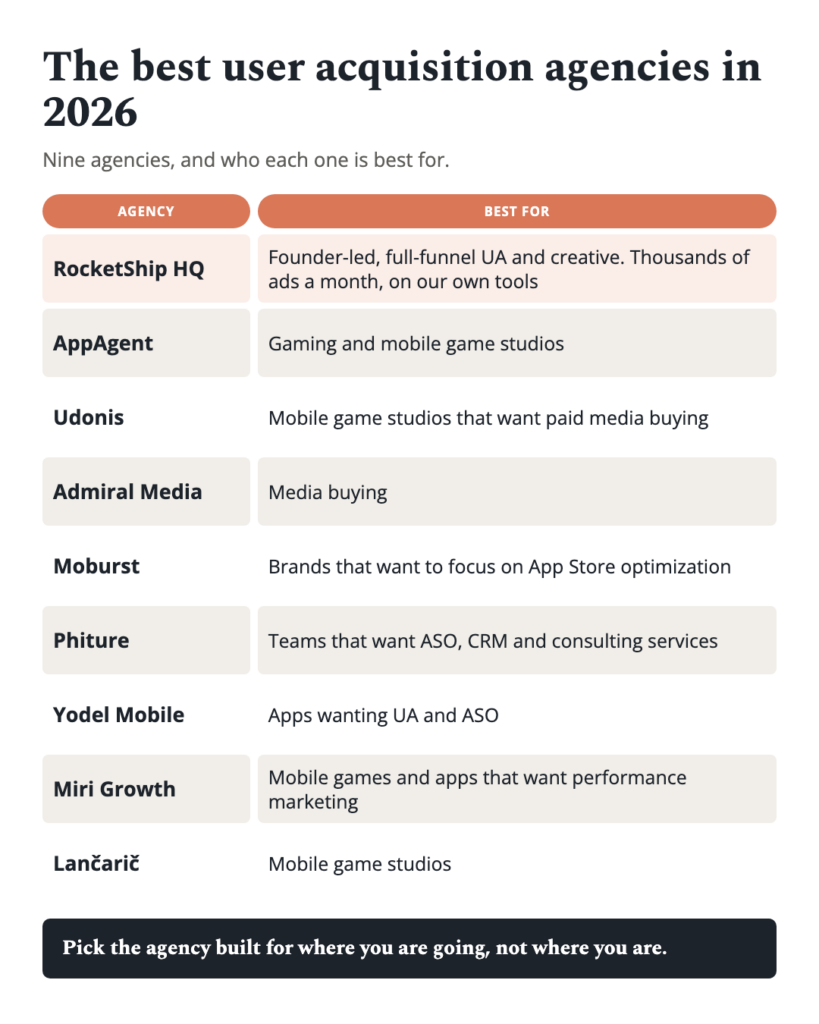
A hook is the experience in the first three seconds of your ad: the moment that decides whether a scrolling user stops, keeps watching, or moves on. To stop the scroll, a hook has to do three things at once: signal who the ad is for, make clear what it is about, and open a loop the viewer wants to close. The strongest mobile app hooks stack four layers (visual, text, verbal, and audio) into that opening window, and they are built to be tested, not perfected on the first try. This guide walks through the frameworks we use to write hooks for mobile app ads, layer by layer.
Page Contents
Why do the first three seconds decide everything?
On short-form platforms, viewers typically decide whether to keep watching, tap, or scroll past within the first three seconds. The rest of the creative, the script, the landing page, and the targeting only matter if the opening earns the next few seconds of attention.
In our experience producing creative for mobile apps, the hook is the single biggest lever we have over how an ad performs. We treat it as the first thing to get right and the first thing to audit when an ad underperforms. For the full picture of how hooks fit into a creative program, see our mobile ad creative strategy guide.
What makes a hook actually stop the scroll? (The 3C Principle)
Every hook should clear three bars. We call them the 3C Principle, and a hook that misses even one tends to lose the viewer.
- Context. Who is this for? The viewer’s brain has to categorize the content instantly, or it scrolls. Establish the category or the person in the opening frame, through visuals as much as words.
- Clarity. What is this about, and why is it worth watching? Precision keeps people in. A confusing opening, even a striking one, leaks viewers.
- Curiosity. An open loop. Created through tension, a contrarian angle, an implied mistake, or an unresolved outcome. No open loop means no reason to keep watching.
A clip that shows someone using your app (clarity) but never signals who would benefit (context) or why they should care (curiosity) will struggle. All three need to land together.
How do you build a hook across four layers? (The 4-Layer Hook System)
A single strong element is good. Strong hooks operate across four layers at once. When the layers align in the opening window, they compound and override normal scroll behavior.
| Layer | Role | Key question |
|---|---|---|
| Visual | Stops the scroll | How do I interrupt the feed? |
| Text | Orients the viewer | What is this about? Why should I care? |
| Verbal | Builds connection | What is the story or argument? |
| Audio | Amplifies emotion | What should the viewer feel? |
The text layer carries its own job: a text overlay should appear on the first frame, stay under 15 words so it reads in a second or two, and open a curiosity gap that only the video can close. Withhold the key piece of information rather than stating the full fact, which closes the loop and removes the reason to keep watching. For a deeper breakdown, see the 4-Layer Hook System for mobile ads.
The audio layer should raise whatever emotion is already present: a riser for tension, a clear vocal tone for authority, an upbeat track for energy, even a sudden silence for contrast. The one rule: never let audio overpower verbal clarity. If the speech is hard to follow, attention drops.
What are the visual hook techniques that interrupt the feed?
The visual hook is the first subconscious interrupt. It does not need to be cinematic. It needs to be noticeable. Instead of asking “what looks good?”, ask “how do I interrupt the feed?” These are the five techniques we work from, with the craft formulas behind each.
- Dynamic movement. Movement increases interruption. A sudden camera zoom in the 0.3 to 0.8 second range, a quick push-in, or fast hand motion turns a flat shot into a pattern break. Static shot + sudden zoom (0.3 to 0.8s) = immediate pattern break.
- Color and contrast. Feeds look visually similar, so contrast stands out. Lift saturation roughly 15 to 25%, raise brightness, or introduce a strong light-dark contrast or a bold color element. Base visual + 15 to 25% more contrast and a slight saturation boost = increased feed standout.
- Context-rich objects. Some objects carry built-in narrative weight: money, cards, statements, a phone showing a dashboard or a number. High-meaning object + close framing + movement = high-clarity visual hook.
- Unexpected imagery. Visual confusion that makes a viewer think “wait, what is happening?” and stay. If you use confusion, follow it immediately with clarity through text or voice.
- The visual hook multiplier. Combining elements compounds the effect. Zoom-in + high contrast + curiosity object + audio cue = high interruption probability.
Before approving any creative, run a quick gate: does something move in the first second, is there real contrast, is the context clear within a second or two, is there a defined audience and an open loop, and is the text readable and native? If three or more answers are weak, rewrite the hook. More examples live in our guide to visual hook techniques for mobile ads.
Which hook elements give you a starting angle?
Once you understand your audience, a handful of elements reliably give you a way in. Pick the one that fits the persona and the tension you are exploiting.
- Emotion. Use emotional language to provoke a response: humor, empathy, curiosity, or urgency. For example, “Do you struggle to fall asleep at night?”
- A question. A thought-provoking question makes the viewer a participant rather than an observer. Keep it relevant to the audience.
- A surprising statement. A claim that challenges what the viewer assumes pulls them toward the resolution. Make it specific and genuinely counterintuitive rather than a generic boast.
- A visual prop. Open on something intriguing or satisfying: a prop tied to the product or audience, or footage that is oddly compelling on its own.
For the verbal layer, we build the opening line from a simple structure: audience + problem or desire + unexpected angle + implied outcome. Start immediately with no “hey guys,” keep the pacing confident, and cut filler. The four types of openers are explored further in four types of ad hooks that work.
Why should you treat every hook as a variable to test?
A hook is a variable, not a final draft. The strongest opener for your app and your audience is usually one you find by testing, not one you reason your way to on the first attempt.
In practice that means writing several openers rather than one. We record five to ten variations of a verbal hook and build two to three visual hook options per concept: a safe version that matches the script, a higher-contrast alternative, and optionally an unexpected pattern-break version. That gives the editor room to test, and it lets the feed tell you which opening actually stops the scroll.
Frequently Asked Questions
How long do I have to hook a mobile ad viewer?
The first three seconds. On short-form platforms, viewers typically decide within those opening seconds whether to keep watching, tap, or scroll past, so the hook has to land almost immediately.
What is the 3C Principle?
It is the three things every hook must do: provide Context (who this is for), Clarity (what it is about and why it is worth watching), and Curiosity (an open loop that makes the viewer want to keep watching). Miss one and the hook tends to underperform.
Should I put my logo or brand intro at the start of the ad?
No. The opening window should arrest attention, not establish branding. Logos and slow intros tend to bleed viewers before the hook ever lands. Get to the hook first and save branding for later in the ad.
How many hook variations should I make?
Treat hooks as variables. A workable starting point is five to ten verbal hook variations and two to three visual hook options per concept, then let testing decide the winner rather than picking one upfront.
Methodology note: the frameworks here (the 3C Principle, the 4-Layer Hook System, the five visual hook techniques, and the craft specs cited) come from RocketShip HQ’s internal creative system, developed across our work producing mobile app ad creative. Guidance is qualitative and craft-based; we have deliberately not attached view-rate benchmarks, because those vary too much by app, audience, and platform to quote responsibly.
Looking to scale your mobile app growth with performance creative? Talk to RocketShip HQ to learn how our hook frameworks can work for your app.
Not ready yet? Get strategies from the leading edge of mobile growth in a generative AI world: subscribe to our newsletter.
Related Reading