The AI video stack we used to replace Higgsfield, Photoshop, After Effects and CapCut, among others

This article is part of a series on making ads with AI. The previous articles in this series are:
- How to analyze 1,000+ competitor ads with AI
- How to stress-test AI competitor ad research before briefing your next ads
- How to break down competitor video ads beat by beat
- How to turn a competitor’s ad structure into new ad concepts (without copying the ad)
- How to turn customer reviews into a creative strategy for your ads
- How to turn a creative strategy brief into a video ad script
- How to make long-form drama ads with AI: three minutes and longer
You started with one AI video tool. Then you added a second, because it had a model the first one didn’t. Then an editor, a voice tool and something for lip sync.
Now you pay for five subscriptions, three of them overlap, and YouTube recommends a new one every week.
A number of people I’ve talked to lately have this complaint. There are too many products, and it’s hard to keep track of them. They suspect they could get most of the value from Claude, Claude skills or Codex, but they aren’t sure what would actually help.
Our answer is to cut out most of the tools in the middle. We buy the models directly, pay by the second, and run our own workflow on top. This article covers the whole setup: which models we use, where we buy them, what they cost, and what you give up by doing it this way.

What are you paying for when you subscribe to an AI video tool?
Higgsfield is incredibly slick. It’s a favorite with a lot of teams, and we used it too.
Then the bills started running into the thousands of dollars, and we began to wonder if there was a better way to do this.
So in June we looked at what our team had actually used on Higgsfield. It was Kling, Nano Banana Pro, Seedance, Grok and Veo. None of our usage was on Higgsfield’s own models. It also has a long list of features, and we never touched most of them.
What we were paying for was mostly an interface and convenience. Every model we used could also be bought from the company that made it, or from an API reseller, at a price per second or per image.
That suits some teams and not others.
-
If you want something quick and easy, use Higgsfield or a tool like it.
-
If you want more control and a lower cost, the rest of this article is what we use.
Which AI video and image models do we actually use?
Fewer than you’d think. Our team makes thousands of images, video clips and audio files every month. We looked at two months of that work, from 23 September to 23 November, to see which models it went to.
Here is where the video clips went.
| Model | Share of our video clips | What we use it for |
|---|---|---|
| Seedance 2.5 | 30% | Long dialogue takes, up to 30 seconds, with the cast and the room supplied as reference images. |
| Kling 3.0 Pro | 25% | A realistic face animated from a single still. |
| Kling 3.0 | 16% | Everyday image-to-video, where we already have the first frame. |
| Kling 4.0 | 12% | Takes guided by reference images and a reference voice. |
| Grok Imagine Video | 7% | Quick, cheap motion, up to 15 seconds. |
| A lip-sync model | 7% | Matching a mouth to a voice track we already have. |
| Everything else | 3% | Older models and tests. |
Images are even more concentrated. Four in five came from one model, Nano Banana Pro, which we use for cast sheets, location sheets and storyboard frames. It has also taken over the retouching we used to do in Photoshop. To change a still, we describe the change. For audio we use ElevenLabs, for voiceover and music.
So you need about five models. The list changes every few months, and keeping up with that is the main thing a subscription does for you. I’ll come back to it.
Where do we buy the models?
From five places. Two are the companies that make the models, and three are resellers.
| Where | What we buy there | Share of our model spend |
|---|---|---|
| Kie.ai | Seedance 2.5 and Kling 4.0 | 61% |
| fal.ai | Kling 3.0, Kling 3.0 Pro and lip sync | 19% |
| Google, direct | Nano Banana Pro and Nano Banana 2 images | 13% |
| Replicate | Grok video, a second Seedance route and some image models | 6% |
| ElevenLabs, direct | Voiceover and music | Under 1% |
What are Replicate and Kie?
They’re resellers. Each one puts models from many different companies behind a single account. You sign up once, add a card, and pay for each second of video or each image you make. There’s no monthly plan and no interface to speak of. fal.ai works the same way.
We use more than one because the same model isn’t the same everywhere. It differs in two ways.
-
The price differs. On 23 November, one second of Seedance 2.5 at 720p cost about $0.23 on Replicate, $0.32 on Kie and $0.47 on fal.
-
The behavior differs. When we tested them, one route accepted realistic human faces and others refused them. The number of reference images you can attach varies too.
That’s why most of our Seedance spend goes to Kie even though Replicate is cheaper per second. For an ad with people in it, the cheapest route is no use if it rejects the cast.
Why not buy Seedance straight from the company that makes it?
If the aim is to cut out the middle, it’s fair to ask why Kie and Replicate are still there.
You can buy Seedance direct. ByteDance makes it and sells it through its own cloud service, BytePlus. On 24 November its list price worked out at about $0.10 a second at 480p and $0.23 at 720p. That’s the same as Replicate, and about a quarter less than Kie.
We still use Kie for films with people in them, because of faces.
-
BytePlus doesn’t take uploaded faces. Its documentation says Seedance does not accept reference images that contain real human faces. You can use its library of preset characters, faces generated on BytePlus itself, or a real person who has been verified and has given permission.
-
Our cast is made somewhere else. We build the cast sheet first, on an image model, and attach it to every scene. Replicate refused our photorealistic cast. Kie accepted it.
-
So the higher price buys the cast. Kie costs more per second, and it lets us keep our own characters in a photorealistic film.
For animation, or for shots with no realistic face, the cheaper routes work, and going direct is worth pricing. We haven’t used BytePlus ourselves, so this comes from its price list and documentation.
A reseller also saves some admin. One account covers many models, so trying a new one doesn’t mean a new account, a new bill and a new way of sending requests.
What does AI video cost per second when you buy it directly?
Across those two months, our video averaged about $0.19 for each second generated, and our images about $0.12 each. Those are estimates from list prices, not our invoices, and they include every retake.
These are the list prices we checked on 23 and 24 November 2026. They change often, so check the provider’s page before you rely on one.
| Model | Bought from | List price |
|---|---|---|
| Seedance 2.5 | BytePlus (ByteDance, direct) | $0.10 a second at 480p, $0.23 at 720p, $0.57 at 1080p |
| Seedance 2.5 | Replicate | $0.10 a second at 480p, $0.23 at 720p |
| Seedance 2.5 | Kie.ai | $0.14 a second at 480p, $0.32 at 720p, $0.79 at 1080p |
| Kling 3.0 | fal.ai | $0.084 a second, or $0.126 with audio |
| Kling 3.0 Pro | fal.ai | $0.112 a second, or $0.168 with audio |
| Grok Imagine Video | Replicate | $0.05 a second at 480p, $0.07 at 720p |
| Nano Banana Pro | $0.134 an image | |
| Nano Banana 2 | $0.067 an image | |
| ElevenLabs voiceover | ElevenLabs | $0.08 per 1,000 characters |
What one 95-second ad costs
A price per second is hard to judge until you apply it to a script. So we priced the script from an earlier article in this series: nine shots, 93 seconds, with people talking on screen in almost all of them.
| Part of the job | What we assumed | Cost |
|---|---|---|
| Cast sheet, location sheet and storyboard | 14 images, each made twice, on Nano Banana Pro | $3.75 |
| Eight dialogue shots, 85 seconds | Seedance 2.5 on Kie at 720p | $26.76 |
| One silent shot, 8 seconds | Kling 3.0 Pro on fal | $0.90 |
| Retakes | Half as much footage again | $13.82 |
| Total | $45.23 |
When we let the planner pick the cheapest model that could do each shot, the total came to about $29. We’d still use the first plan, because it uses the routes we know accept our cast.
What two finished films cost
That 95-second ad is only a plan. We’ve also finished two films of about three minutes each, and the previous article shows how each was made.
| Front Row | Stephen? | |
|---|---|---|
| Kind of film | Animated, with a voiceover | Photorealistic, with characters who speak |
| Video model | Grok | Seedance 2.5 |
| Cost of generation | About $25, everything included | At least $136, video only |
| Length of the finished film | 3 min 34 s | About 3 min |
| Video we generated to get it | 4 min 54 s | 7 min 11 s |
| Video cost per finished second | About $0.07 | About $0.75 |
Stephen cost more because its characters speak on screen. Dialogue needs the more expensive model, and more of its takes get thrown away.
We made both films when our team was just getting started with this process, so treat these as conservative numbers for a first attempt.
All of these figures cover the models only. They leave out the time of the person who writes the script, reviews the takes and cuts the ad. And the retake rate in a plan is a guess until you’ve made a few films. We’d start by allowing half as much footage again.
What sits on top of the models?
Four things. A subscription tool gives you its own version of each. We wrote or built ours, and the first three are free to download.
-
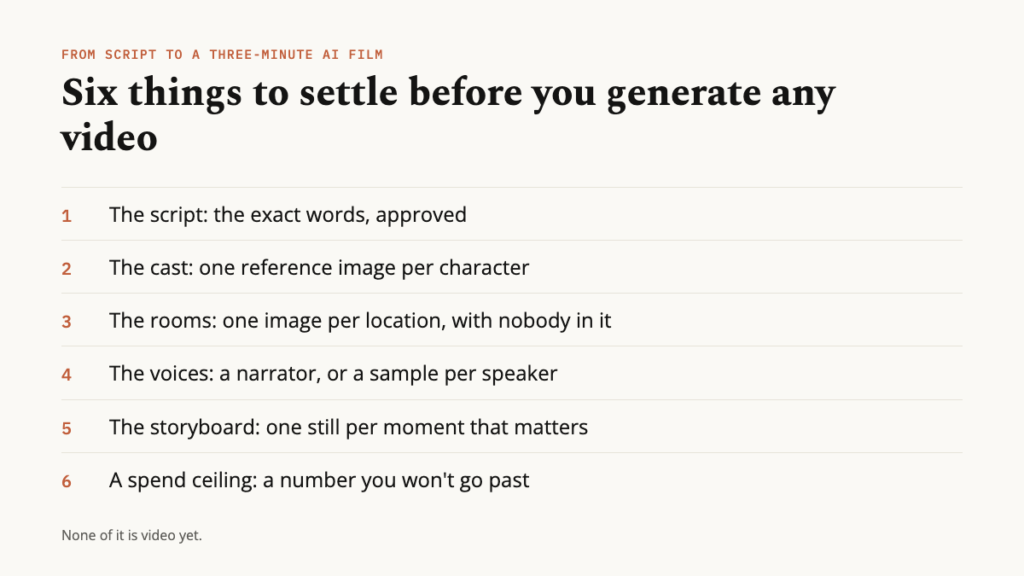
Skills. These are written instructions that an AI assistant such as Claude follows. Ours take a script through a cast sheet, a storyboard, the takes and the edit. They stop for a person’s approval at three points: the script, the storyboard and the finished film. The public version is AI Video Maker.
-
A thin layer of code. It sends a request to the right provider, waits, downloads the result and files it. It also keeps a log of every job and what it cost. That code ships inside AI Video Maker, and you can read it on GitHub. It runs on your own API keys.
-
Local editing. We join the selected takes, add voiceover and music, and burn in captions from the approved script. This is the work we used to do in CapCut and After Effects. It now runs on the editor’s own machine with FFmpeg, which is free, and the script for it is in the same download.
-
People. Someone still has to decide which take is right.
The skills are the part people ask about most. A lot of what an interface does is remember a good order of work. A skill holds that order in a text file, and you can change it when you learn something.
What do you give up by buying the models directly?
Quite a lot, and you should know it before you cancel anything.
-
An interface. We had to build a gallery page so the team could see and reuse each other’s work. If nobody on your team can do that, the subscription is worth paying for.
-
Someone else keeping up with the providers. While writing this article, I found that two of the routes in our own system had stopped working. Google had removed Veo 3.1 from the API we used, and OpenAI had retired the image model we called. Nobody on the team had noticed, because they’d already moved to other models. A subscription tool handles that for you.
-
Someone else absorbing failures. About 1% of our requests fail. Some providers return a blocked video with no file and a reason you have to go looking for. Some give you a download link that expires, so you have to save the file at once.
-
A ceiling on your spend. A subscription can’t cost more than the subscription. Paying per second can, especially if an AI agent is making the requests. We set a maximum per request and per person per day, and you should too.
If you make a handful of videos a month and nobody on the team writes code, keep the subscription. Buying direct starts to make sense when you’re making a lot of video, when you keep hitting the limits of the interface, or when you want a workflow you can change yourself.
How do you start without building all of this?
Start with the planning, which costs nothing.
-
Take one script. Break it into shots and note, for each one, how long it is, whether anyone speaks on screen, and whether a realistic face is visible.
-
Price it. Work out which model each shot needs and what the whole video should cost with retakes.
-
Compare. Put that number next to what you pay each month and how many videos you actually make.
-
Then try one model on one provider. Make the cast sheet and one shot before you build anything.
AI Video Maker
This is our workflow and the code under it, in one download. Start with the pricing step: give it your shots and it picks a model for each one and adds up the cost with retakes. That step needs Python and no API key. When you’re ready, it builds the cast and room references, lays out the storyboard, generates each scene with your own keys and assembles the film.
The previous part of this series shows the skill at work on two films, from the script to the finished cut.
Published